Research data on Mondrian’s Victory Boogie Woogie now available online
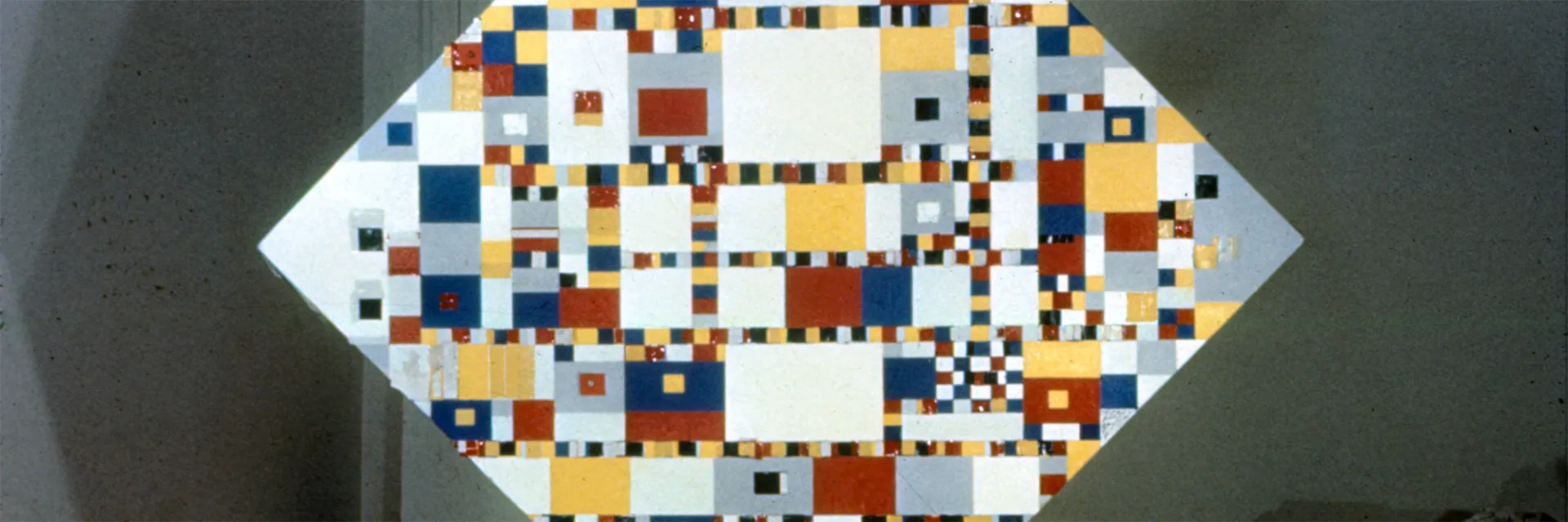
The results of six years of technical research are available through RKDtechnical.
Victory Boogie Woogie
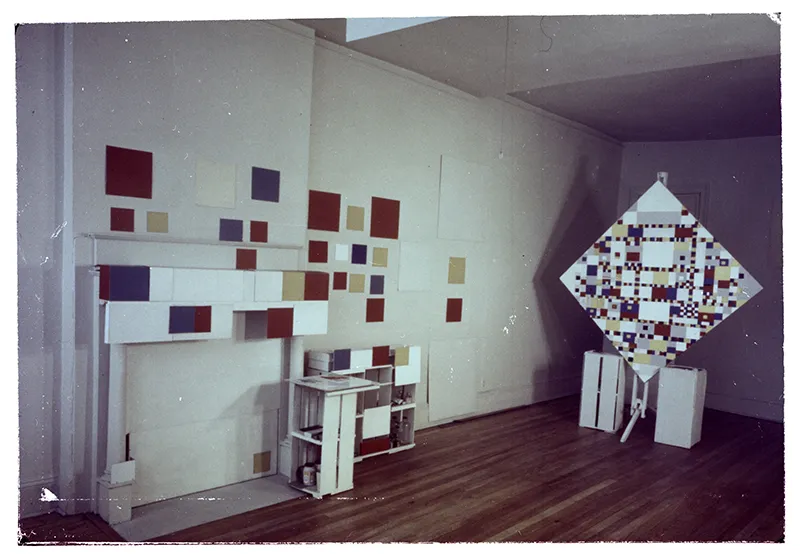
After moving to New York in 1940, Mondrian began to explore new directons. Having worked for years with his characteristic visual language of black lines and coloured rectangles, he began to develop compositions in which lines and areas of colour merged more closely with one another. In June 1943, he wrote about this: ‘I have changed a little my way of painting and this effort has taken me entirely. But I found a way which pleases me better: I have broken my lines so that they appear as little color-squares and broken also the white planes. In this way the picture becomes more dynamic.’ This new dynamism ultimately found expression in just two works, including Victory Boogie Woogie, which he had begun in 1942. Upon Mondrian’s death in 1944, the painting remained unfinished on the easel in his studio.
Technical research
From 2006 to 2012, Victory Boogie Woogie was extensively studied by international experts regarding its materials. This research project was a joint initiative of the Cultural Heritage Agency of the Netherlands (RCE) and the Kunstmuseum Den Haag. The aim was to gain a better understanding of the work’s history and Mondrian’s working methods. This research centred on questions relating to the materials and construction of the work. Would it be possible to trace the history of the canvas? And what might the artwork tell us about the artist and his way of thinking and working?
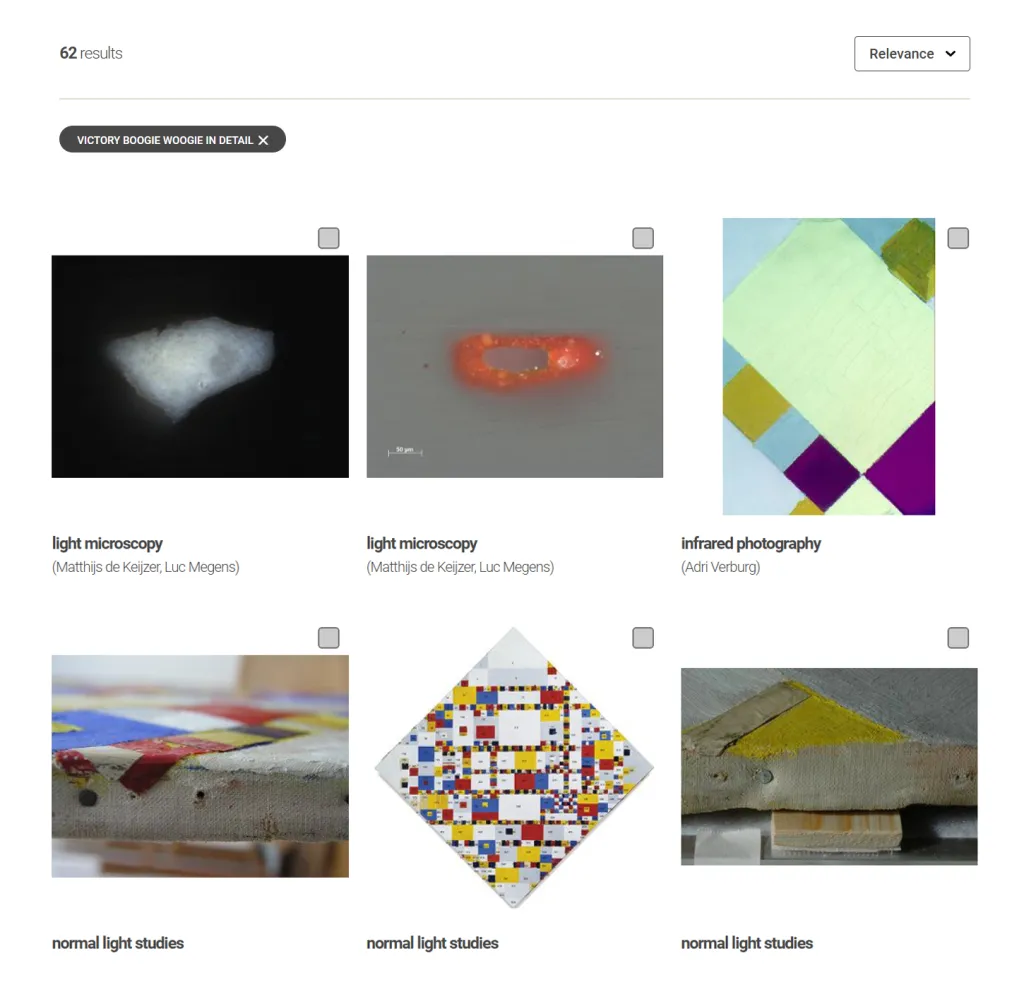
The research employed a range of methods, including photography using raking light, UV fluorescence and (transmitted) infrared light, XRF spectroscopy, analysis of samples and stereomicroscopy. Digital reconstructions of the painting were also produced. The research findings were published at the time in the book Victory Boogie Woogie Uitgepakt (Amsterdam University Press, 2012).
Digitisation to stimulate future research
Over 21 GB of source material from the research project has now been made digitally accessible. This ensures that the data is preserved for the future and remains available for new research. The release of the dataset is part of the E-RHIS project Victory Boogie Woogie in Detail, a collaboration between the Cultural Heritage Agency of the Netherlands (RCE), the Kunstmuseum Den Haag and the RKD – Netherlands Institute for Art History.
The data can now be consulted via RKDtechnical, RKD Research’s database for technical research into works of art. This database brings together technical documentation from museums, conservators, universities and other heritage institutions. With the addition of this data, RKDtechnical now contains more than 16,000 research records.
The source materials from the Victory Boogie Woogie Uitgepakt research project are presented in their original, unedited form, without interpretation or commentary. Direct access to these primary sources creates opportunities for new lines of inquiry, enables users to develop their own interpretations, and supports a deeper understanding of both the artwork and Mondrian’s artistic practice.
Collaboration
The digitisation of these source materials forms part of an E-RIHS project undertaken in partnership with the Cultural Heritage Agency of the Netherlands (RCE) and Kunstmuseum Den Haag. The project is linked to the exhibition opening in September 2027, where Victory Boogie Woogie and Broadway Boogie Woogie will be shown together in the Netherlands for the first time in over eighty years.