
A new perspective on the Huis Driemond ensemble

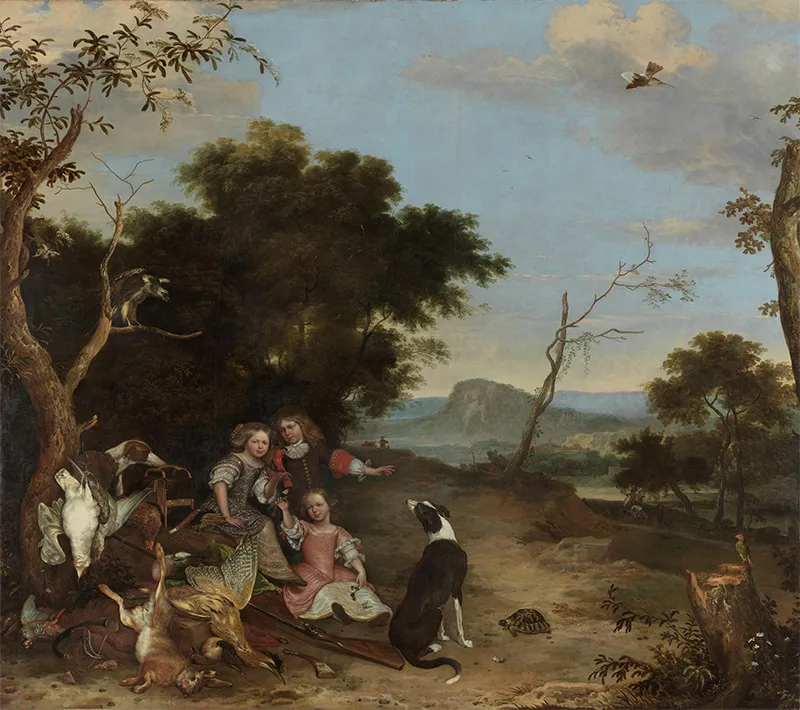
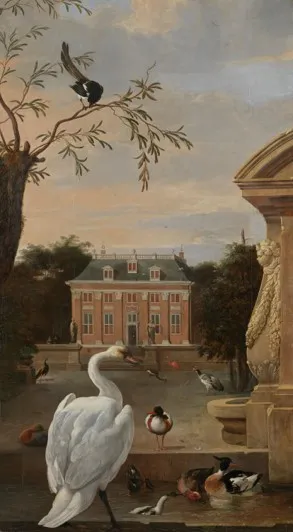
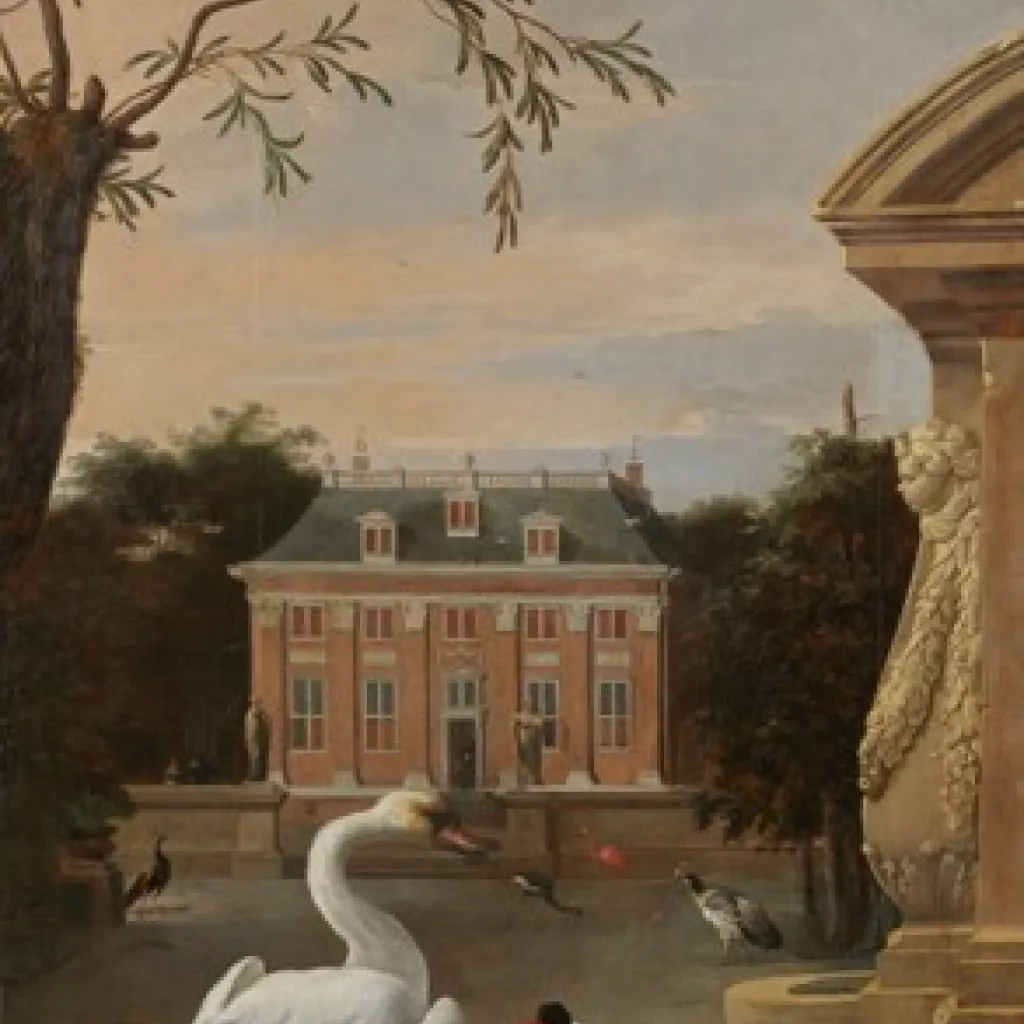
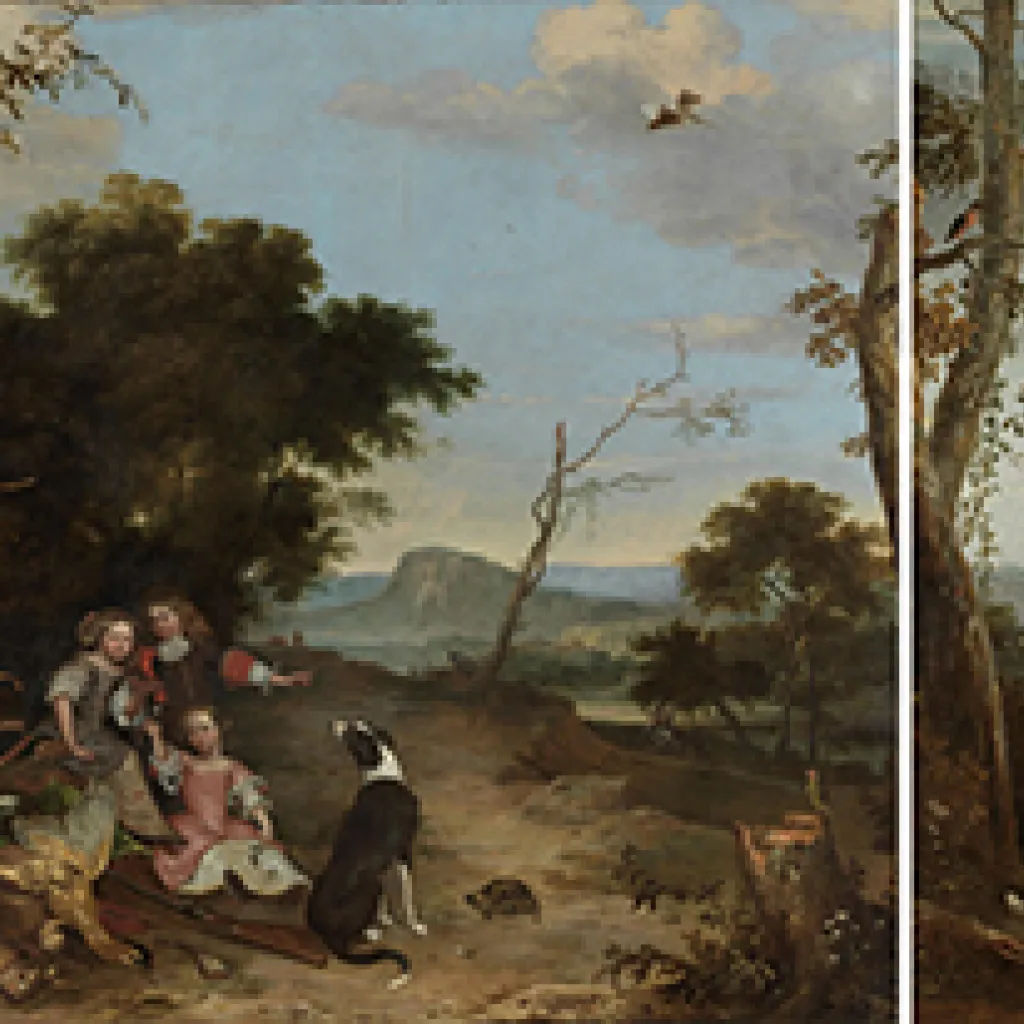
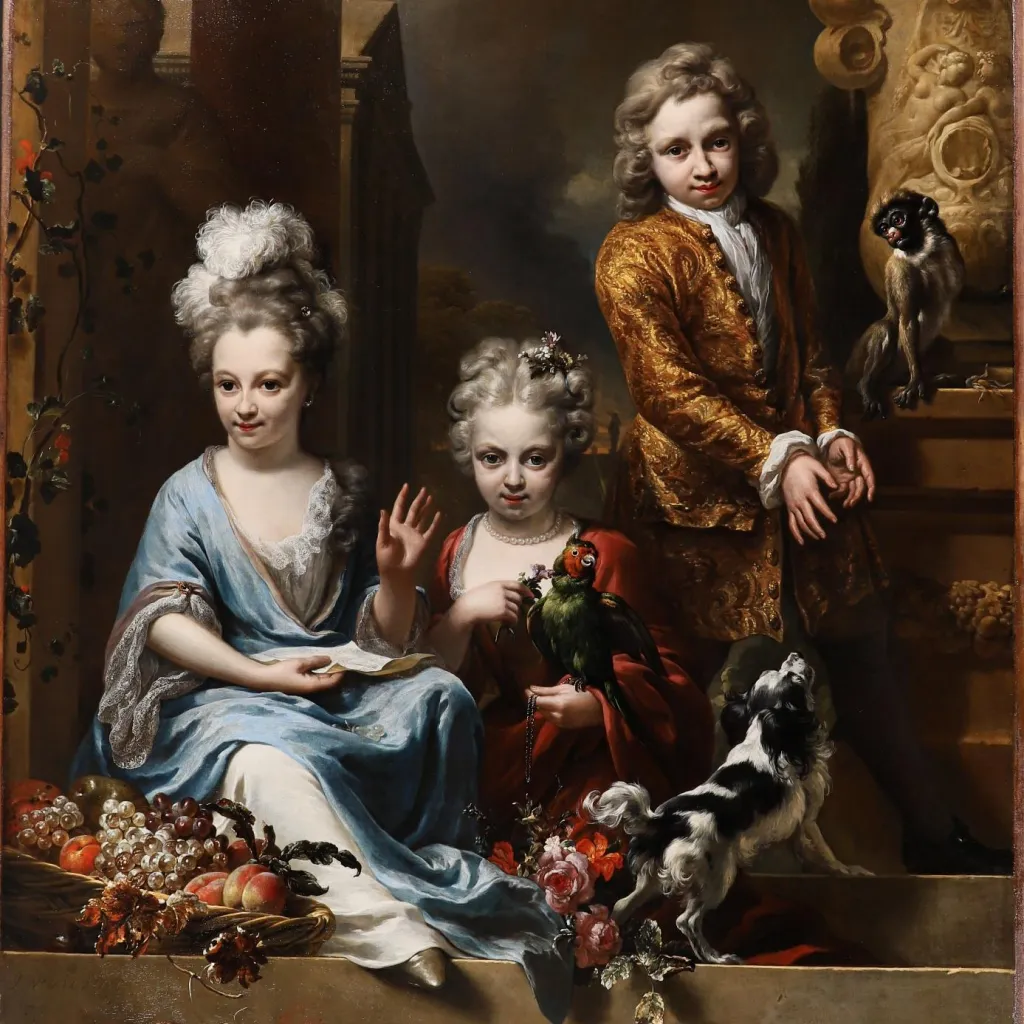
The Bayerische Staatsgemäldesammlungen in Munich houses four monumental paintings from Huis Driemond, near Weesp, which form a single ensemble. The paintings show portraits of the children of Adolf Visscher (1644-1701) and Anna Maria Pelt (1645/1646-1673), as well as animal and hunting motifs. Two canvases in the series are particularly noteworthy: Portrait of Three Children of Adolf Visscher and Anna Maria Pelt in a Landscape with Hunting Booty, because of the high quality of the children's portraits, and Landscape with Birds, Huis Driemond in the Background, because the house itself is depicted (figs. 1 and 2). During an internship at the RKD, Fee van de Ven researched who painted these works and when, for which room in Huis Driemond they were intended, and how they were displayed there.
Huis DriemondFootnote1
Huis Driemond was built around 1642 by Gerbrand Anslo (1612-1643) at the confluence of the rivers Gein and Gaasp, east of Weesp.Footnote2 Philips Vinckboons (II) (1607/1608-1678) drew the designs and supervised the construction. A few years after Anslo's death, the country estate was purchased by two brothers from the Pelt family, after which Huis Driemond came into the possession of Anna Maria Pelt and her husband, the Amsterdam sugar refiner (‘suikerbakker’), insurer, and shipowner Adolf Visscher in 1668. It is likely that Huis Driemond served as a country house, as Visscher and Pelt also owned a town house on the Rokin in Amsterdam. After Adolf Visscher's death, the house was sold in 1702 to Cornelis van Laer (1651-1721), at which time an inventory of the estate was drawn up. The house changed hands several more times over the following decades and was eventually demolished in the second half of the nineteenth century.
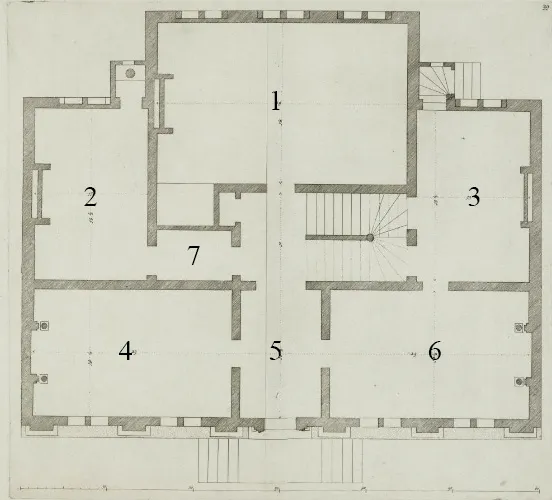
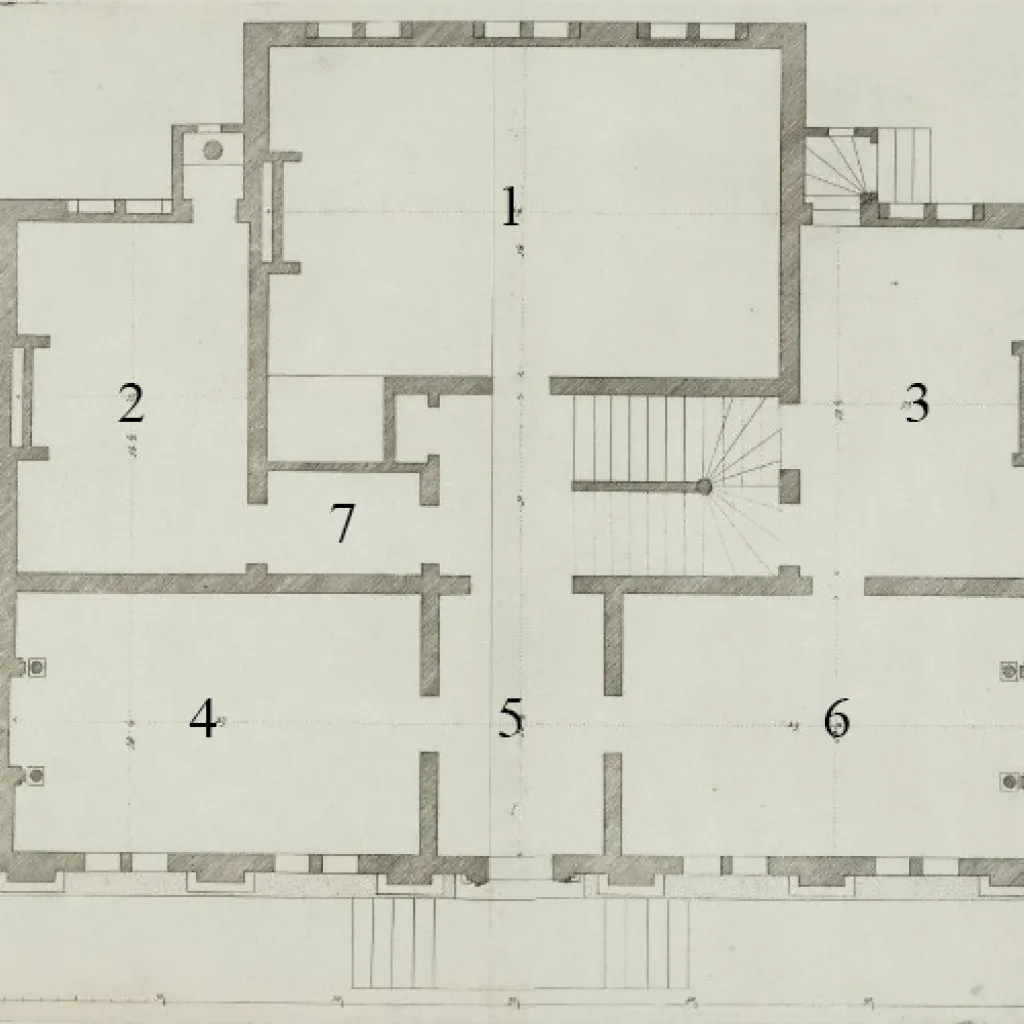
Only one floor plan of the house is known; although undated, it was published in 1648.Footnote3 It shows a symmetrical, classicist-oriented layout. A central corridor led from the entryway to the downstairs hall, which partially extended beyond the building block (fig. 3). On the ground floor, there were mirror-image rooms on either side of this axis. On the upper floor, there were four spacious bedrooms, a small room, and an ‘upper hall’. The basement was the domain of the staff, while the ground floor and upper floor accommodated both daily living and the reception of guests.Footnote4 The inventory from 1702 lists more than fifty paintings, including works by Melchior’Hondecoeter (1635-1695), Pieter de Hooch (1629-1679), and Emanuel de Witte (1617-1692).Footnote5 Four ‘chassinets’ by d’Hondecoeter probably referred to the Huis Driemond ensemble. These works hung in the side room and, together with several ‘attic pieces’ (zolderstukken), were valued at 800 guilders.Footnote6 These ‘attic pieces’ probably referred to ceiling decorations; it is unknown whether these were later lost.
According to Ottenheym, the side rooms on the ground floor were furnished as private quarters, but the amount of 800 guilders for the ensemble suggests that it was a considerable investment with a possible status-enhancing function.Footnote7
Reconstruction of the ensemble
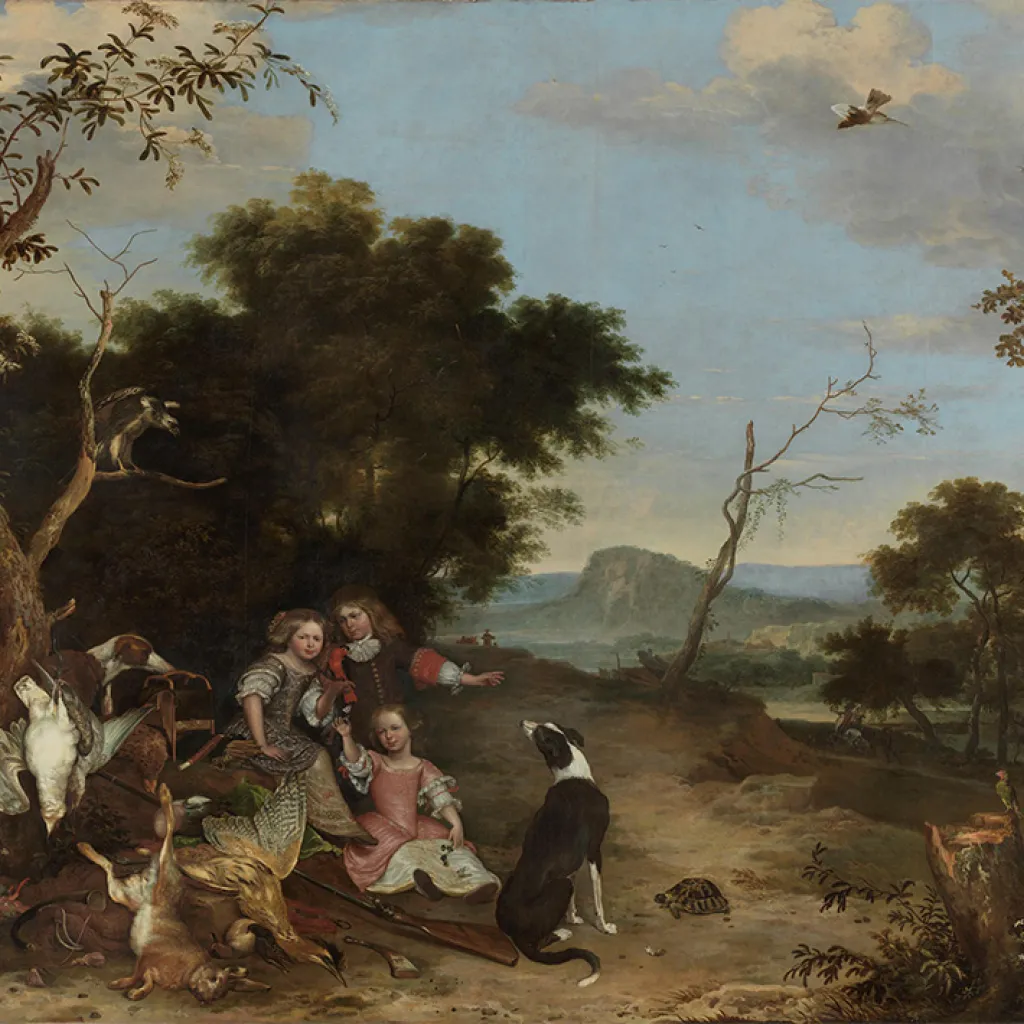
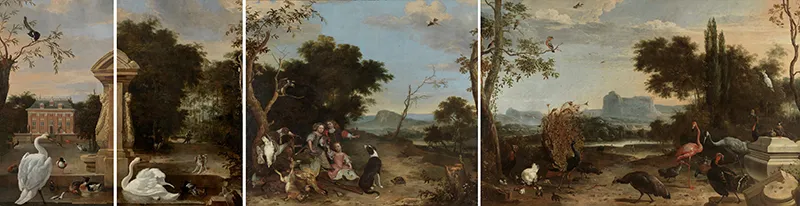
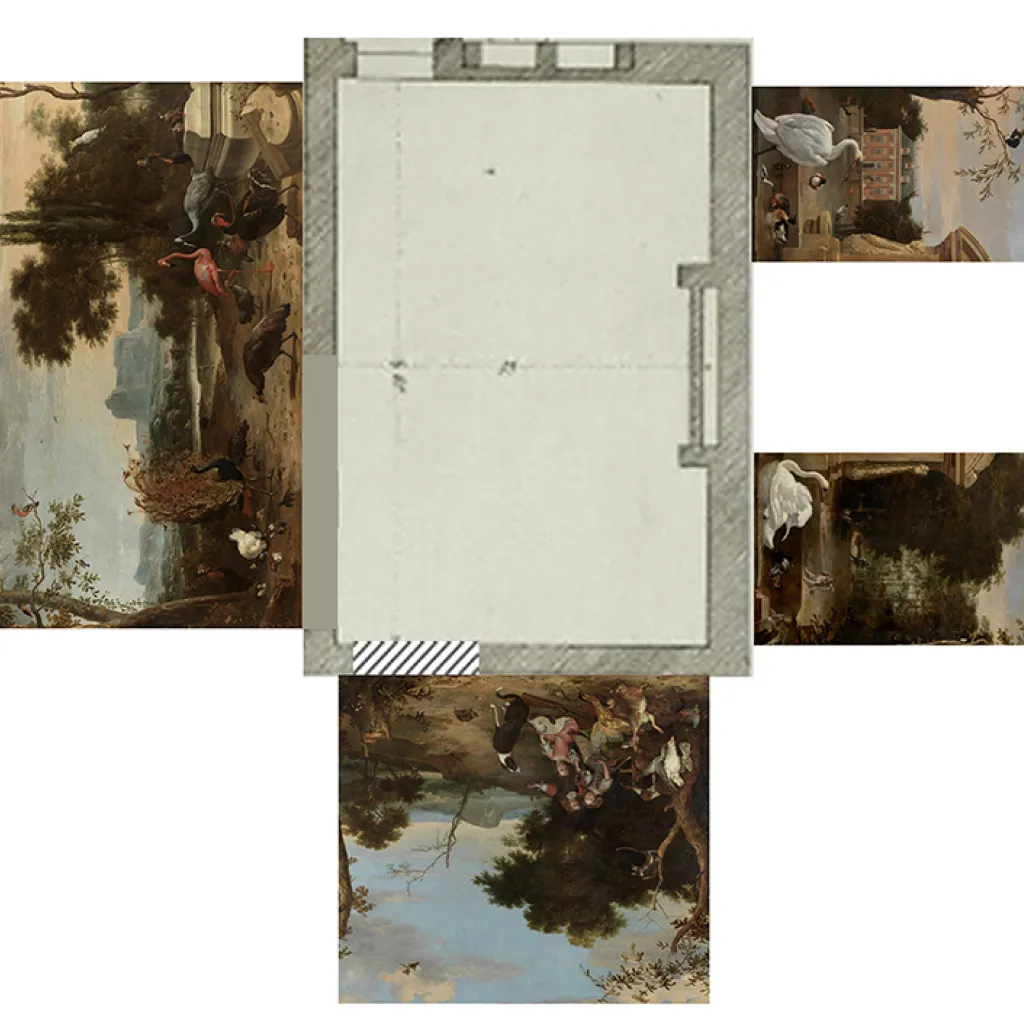
Where were the four paintings hung at Huis Driemond? Reconstructing their arrangement is complex and must be based on both stylistic and architectural arguments. For the stylistic analysis, we first examine the paintings. The ensemble comprises four canvases, which together form a varied decorative program. The narrow canvas Landscape with Birds, Huis Driemond in the Background shows a swan at the water's edge, flanked on the right by an architectural fragment, with Huis Driemond in the background (fig. 2).Footnote8 The wide canvas Landscape with birds depicts a landscape featuring chicks, chickens, a peacock, and a flamingo, as well as several stone pedestals on the right (fig. 4, right). The second narrow canvas, Wooded Landscape with Birds and a Barking Dog, repeats the swan, now accompanied by a barking dog, with a man and a woman on a forest path visible in the background. On the left is another architectural fragment that mirrors that of the first narrow canvas (fig. 4, second from left). The ensemble is completed by Portrait of Three Children, which depicts three children in a landscape, surrounded by dogs and hunting attributes (fig. 1).
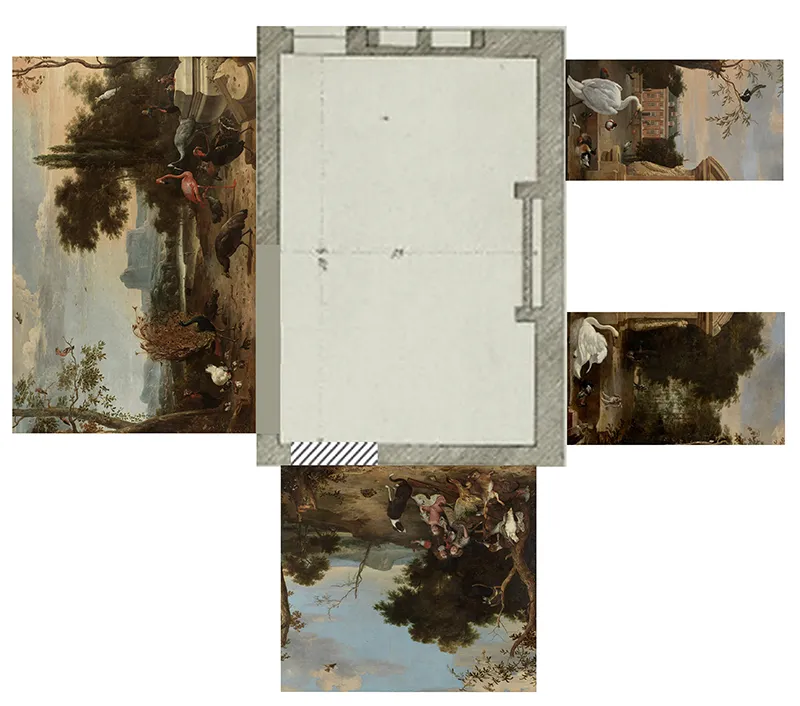
According to Rikken, the ensemble hung in a side room on the ground floor. This was probably the ‘day room’ (fig. 3, no. 3).Footnote9 Rikken suggests that the two narrow canvases may have hung on either side of the fireplace and the widest one on another wall, while the fourth painting, Portrait of Three Children, may have been placed above the fireplace. However, this seems unlikely, as it is 341.5 cm high, making it difficult to fit above a fireplace.
Looking at the architectural drawing of the house and the way in which the paintings connect, the most plausible arrangement is shown below (fig. 4 and 5). In this order, specific details, such as the sky and the trees between the second and third, and the third and fourth canvases, blend seamlessly into each other. Looking at the recurring motifs, the first canvas on the left is more difficult to place in the whole. However, the light in both narrow paintings is the same, suggesting that they were made for the same wall. The colors of the first narrow canvas and the widest, fourth canvas also match; both show warm, low sunlight tones, consistent with the presence of a window on that side. Although a combination of architectural and stylistic clues makes this arrangement the most obvious, we also encounter a problem. The connection to the painting room (fig. 3, no. 6) must either have been bricked up, or the painting with the children's portraits would, if it had been in the position outlined here, have had to hang partly in front of the doorway.
An alternative location is the downstairs hall (fig. 3, no. 1). This would be possible in terms of space for the canvas with the children's portraits, but the two narrower canvases would not fit next to the fireplace. The available space there is only 123 and 164 cm, while the paintings are 188 and 209 cm wide respectively.Footnote10 Moreover, the paintings would also lose their compositional continuity. Therefore, despite the obstruction of the door to the painting room on the floor plan, the reconstruction in the day room is still the most plausible. It is important to note that only one floor plan of Huis Driemond is known (fig. 3) and that Adolf Visscher was the third owner: it is possible that the room layout had been changed by the time he ordered his decorative ensemble.
Dating
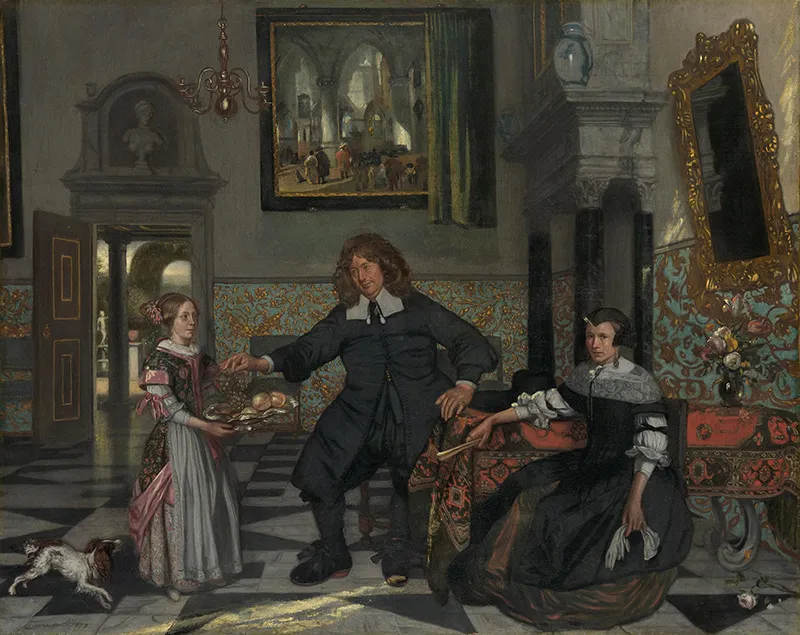
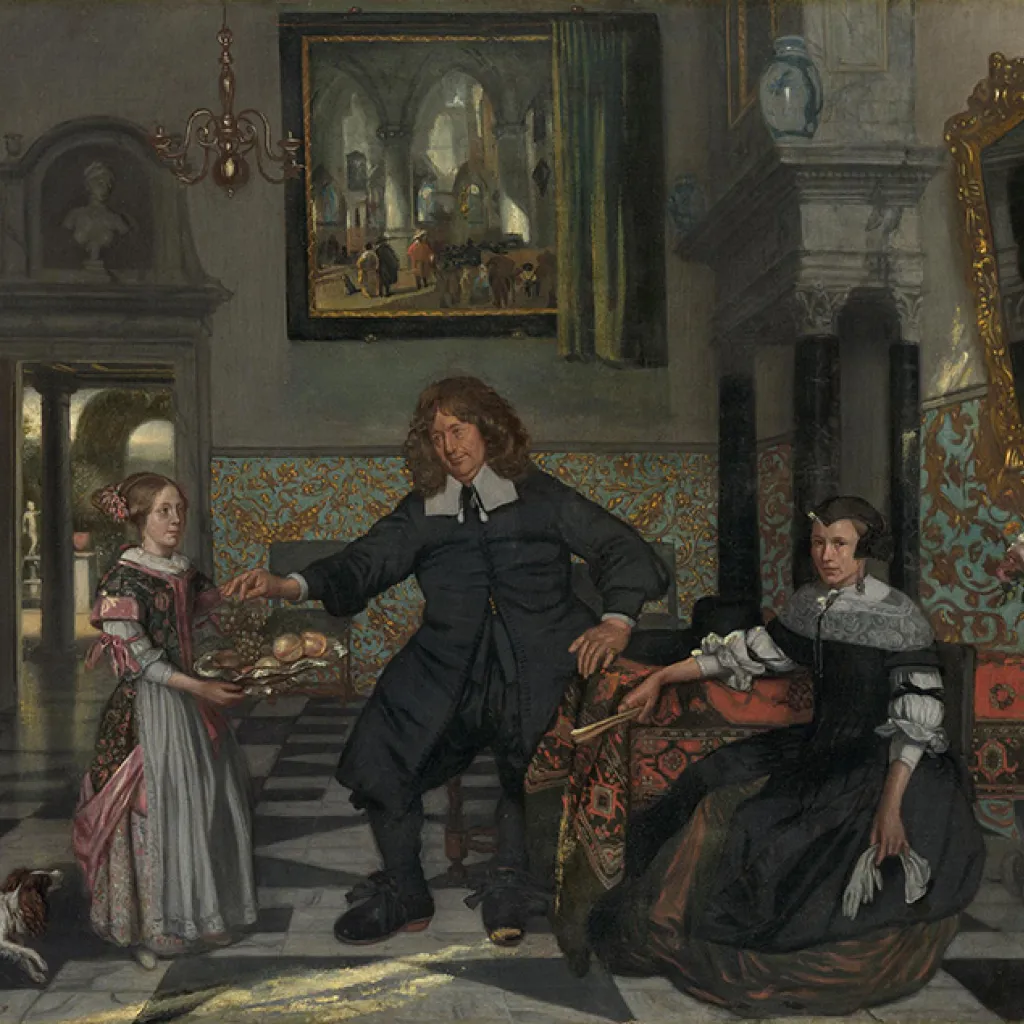
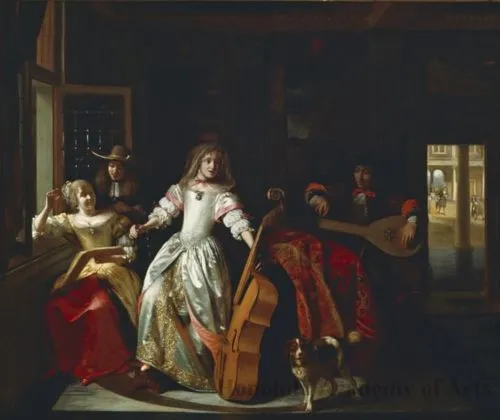
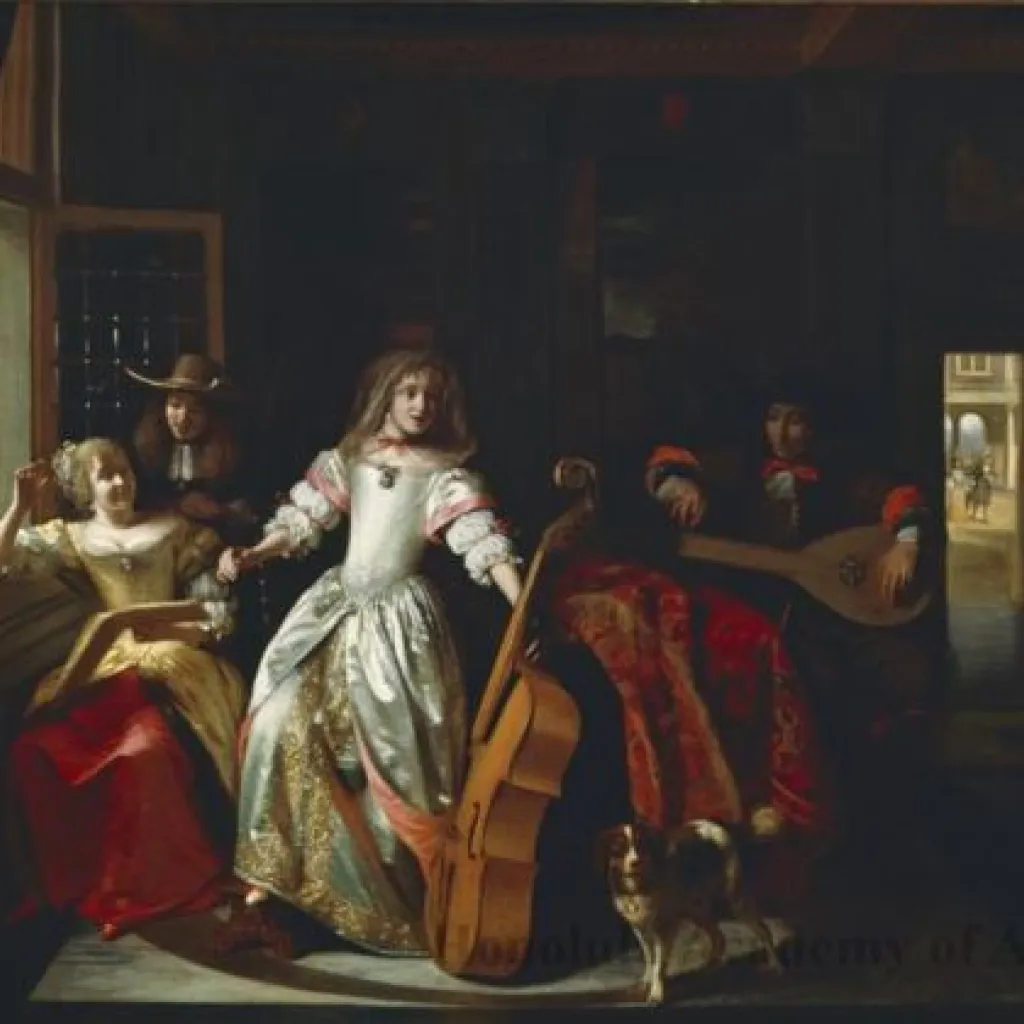
The Huis Driemond ensemble is generally dated to around 1670 in the literature.Footnote11 However, based on information from baptism, marriage, and burial records and the clothing worn by the children portrayed, this date can be shifted to approximately 1676-1678.Footnote12 Three children are depicted in the group portrait: Johannes (1668-1718), Anna Maria (1669-1750), and Elisabeth (born 1672). Elisabeth appears to be four to six years old in the portrait. A date in the second half of the 1670s also fits better with the children's clothing and hairstyles. The girls wear bows around the loose-fitting sleeves of their undershirts, causing them to bulge slightly. Their skirts are slightly shorter at the front, revealing an underskirt of a different color. The neckline is wide and has few elaborate decorations. The costumes closely resemble the clothing worn by the girl in Emanuel de Witte's Family portrait, dated 1678 (fig. 6). Similar clothing and hairstyles also appear in paintings by Pieter de Hooch from the same period, such as Musicians in an Interior from 1674 (fig. 7) and Elegant Company in a Courtyard from 1677. Since the children's mother had already passed away by that time, it must be concluded that their father, Adolf Visscher, commissioned the ensemble.
Attribution
It has long been assumed that Melchior d’Hondecoeter was responsible for the execution of the four paintings, an attribution that can be argued for on stylistic grounds.Footnote13 Characteristic motifs such as hares, chicks, turtles, barking dogs, and hunting attributes, correspond to other works by the artist, such as Still Life with Hunting Booty with Dead Hare, Wild Boar, Partridges, and Hunting Equipment (1668), Hunting Booty with Dead Hare, Hunting Booty near a Staircase (ca. 1678), Crane, Peacock, Chickens, and Ducks in a Formal Garden, and Birds and a Spaniel in a Garden.Footnote14
It is less clear whether d’Hondecoeter also painted the children’s portraits. He is mainly known as a bird and hunting painter, and no independent portraits by him are known to exist. The portraits in his oeuvre, such as Girl with Peacocks, are often assumed to be the result of collaborations with portrait painters, with d’Hondecoeter responsible for the fauna and landscape.Footnote15 For the children's portraits in Portrait of Three Children, an attribution to Jan de Baen (1633-1702) is therefore more likely, not only because of his presumed contribution to Girl with Peacocks, but also because of the stylistic similarities between his portraits and those in the Driemond ensemble.
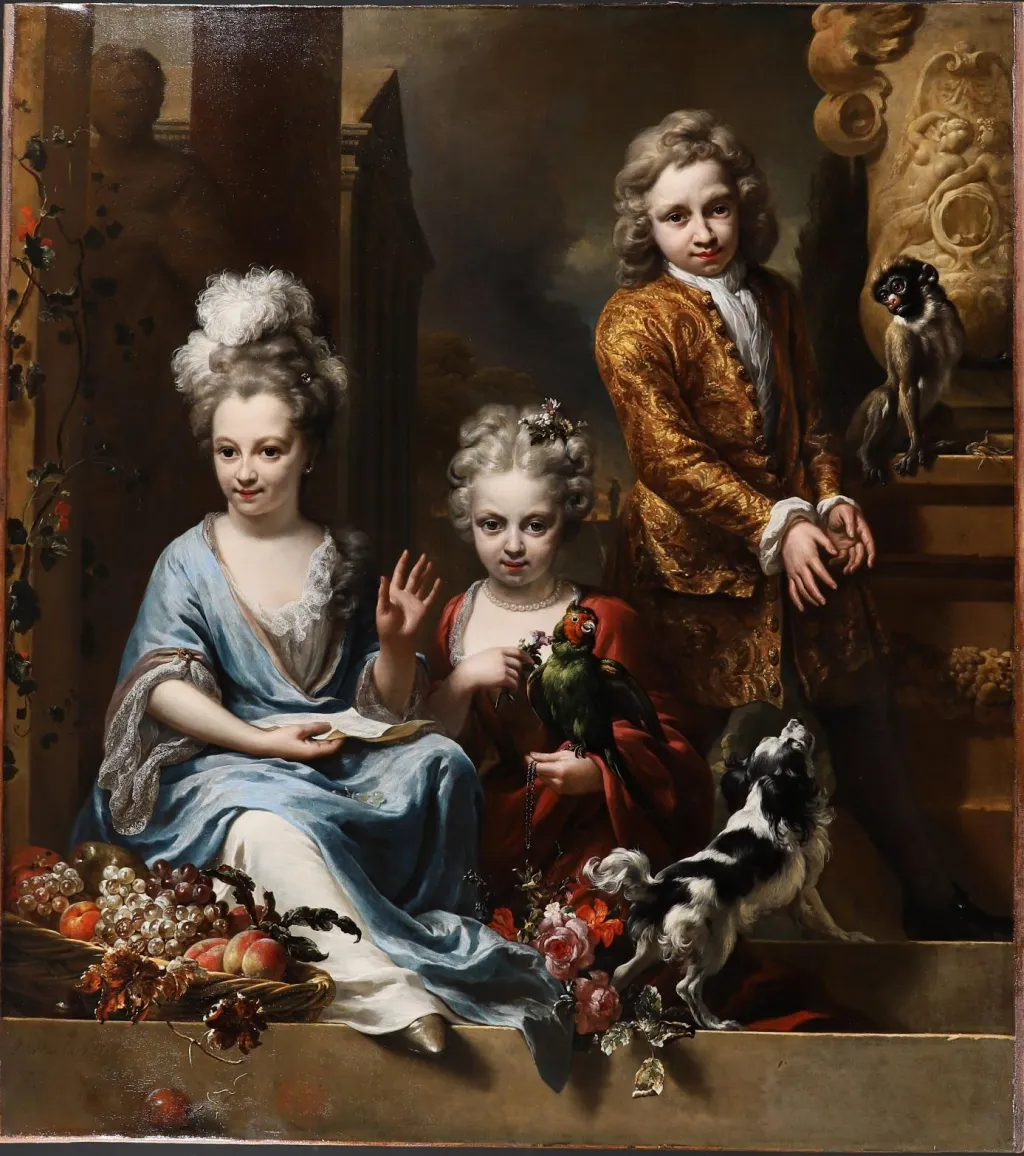
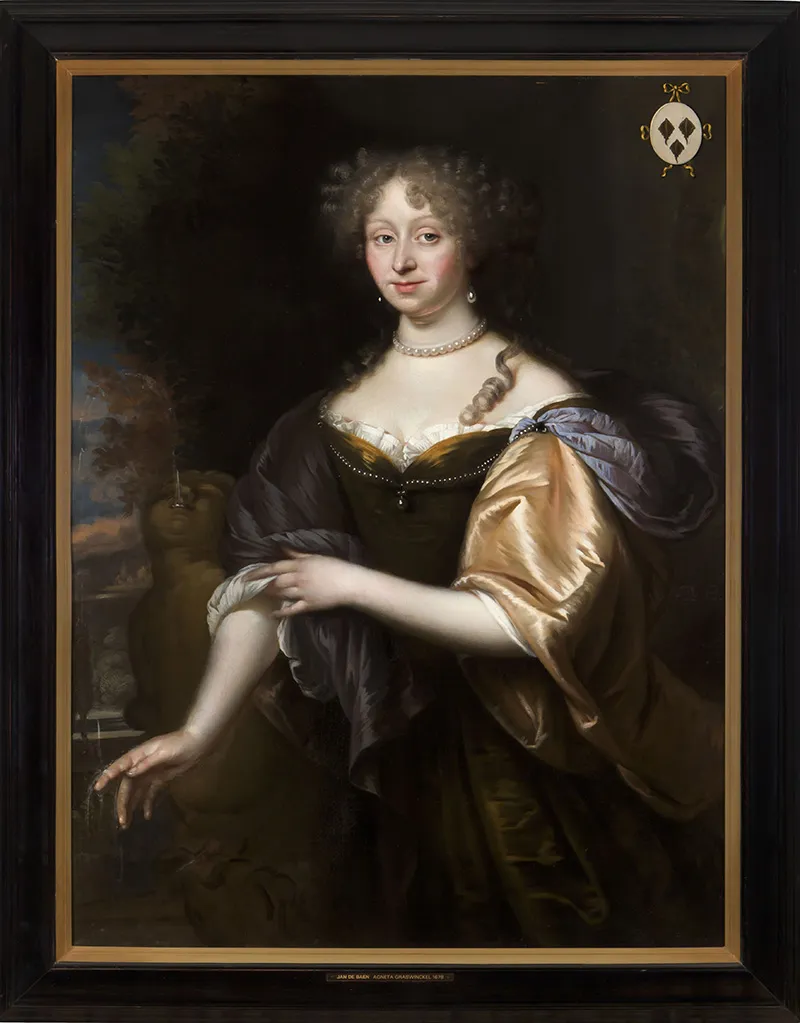
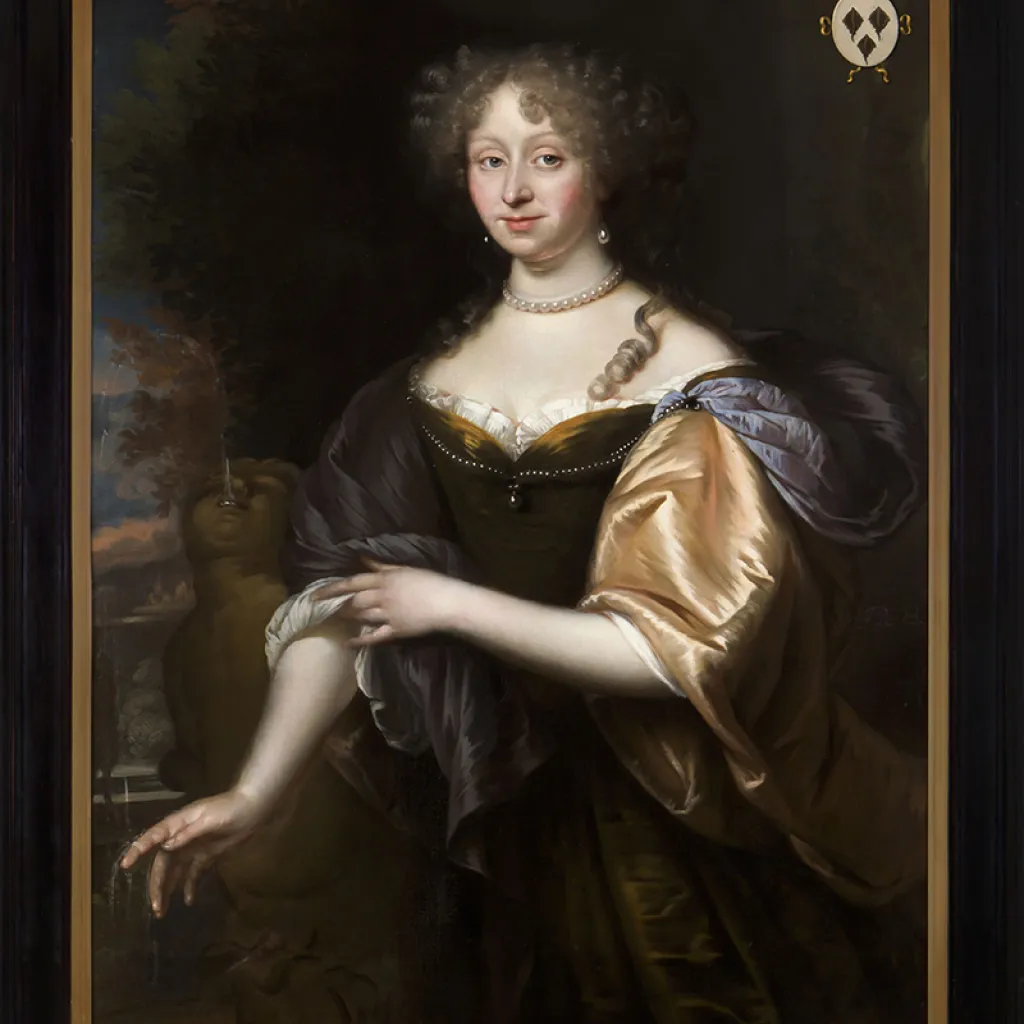
An alternative attribution of the portraits to Jan Weenix (1641-1719) has also been suggested. In a collection catalog from 1905, the entire Driemond ensemble is even attributed to him, although the exact reasoning behind this is unknown.Footnote16 The relationship between Weenix and d’Hondecoeter—they were cousins and both worked in the studio of Jan Baptist Weenix (1621-1659) ─ makes such a hypothesis quite plausible. However, there are hardly any known portraits by Weenix from before 1680. Before that year, he concentrated mainly on still lifes and hunting scenes, which makes his involvement as a portraitist in paintings by d’Hondecoeter seem less likely. Although certain stylistic characteristics, such as the depiction of the mouths and chins, bear some resemblance to his signed Group Portrait of Three Children from 1707 (fig. 8), the painting style and use of color in the children's portraits are more closely aligned with the style of Jan de Baen. In particular, the modeling of the eyes and mouth, the subtle shadows under the eyes and along the nose, and the soft light around the cheeks show clear similarities with children's portraits attributed to De Baen, such as Double Portrait of Ida van Ittersum and her son Ernst Hendrik van Ittersum, but also with his signed Portrait of Agneta Graswinckel (1641-1727) from 1678 (fig. 9).
Although there is no direct evidence of collaboration between De Baen and d’Hondecoeter, it is likely that the two artists knew each other and each other’s work through their network in The Hague. D’Hondecoeter became a member of the Hague Confrérie Pictura in October 1659 and served as its chairman in 1662. He remained in the city until 1663. De Baen also lived and worked in The Hague. Moreover, although De Baen worked mainly in The Hague, he also accepted commissions in Amsterdam, where he authorized someone to collect payments on his behalf.Footnote17 It is therefore quite possible that d’Hondecoeter, who was active in Amsterdam in the 1670s, asked De Baen to paint the children’s portraits for the Huis Driemond ensemble.
Conclusion
The Huis Driemond ensemble displays Melchior d’Hondecoeter’s characteristic animal and hunting motifs, but the portraits of children are not his work. It is much more likely that they were painted by Jan de Baen, who may have collaborated with d’Hondecoeter on other occasions. Based on genealogical data and the children’s clothing, the ensemble can be dated to around 1676-1678. The proposed reconstruction of the placement of the paintings in Huis Driemond suggests a wall-filling ensemble that presumably hung in the ‘day room’ on the ground floor.
Author

- Back to footnote 1 in the text
The literature consistently identifies Adolf Visscher and Anna Maria Pelt as the patrons of the ensemble: G. Leonhardt, ‘Een Vingboonshuis geschilderd door Hondecoeter’, Amstelodamum 52 (1960), pp. 90-96; I.H. van Eeghen, ‘Christoffel Beudeker, suikerbakker en verzamelaar’, Amstelodamum 71 (1984), pp. 97-105; K. Ottenheym, Philips Vingboons (1607-1678), architect, Zutphen 1989, p. 62; C. Bertram and E.A. de Jong, Noord-Hollands arcadia. Ruim 400 Noord-Hollandse buitenplaatsen in tekeningen, prenten en kaarten uit de Provinciale Atlas Noord-Holland, Alphen aan den Rijn 2005, pp. 83-84; M. Rikken, Melchior d’Hondecoeter, bird painter, Amsterdam 2008, pp. 31-32 ; G. van Oosterom, Boeren op de buitenplaats. De relatie tussen landbouw en buitenleven in het Amstellands Arcadië (1640-1840), Groningen 2022, p. 161.
- Back to footnote 2 in the text
Ottenheym 1989 (see note 1), p. 62; Bertram and de Jong 2005 (see note 1), pp. 83-84.
- Back to footnote 3 in the text
P. and J. Vingboons, Afbeeldsels der voornaemste gebouwen uyt alle die Philips Vingboons geordineert heeft, Amsterdam 1648.
- Back to footnote 4 in the text
Ottenheym 1989 (see note 1), pp. 61-63.
- Back to footnote 5 in the text
Municipality of Amsterdam, Archive of the Notaries of Amsterdam (access number 5075), minute deeds nos. 5322-5343 (1681-1723), deed no. 5335 (1702-1703), scan series 208.1.19.
- Back to footnote 6 in the text
A chassinet is a painted canvas stretched over a frame and illuminated from behind.
- Back to footnote 7 in the text
Ottenheym 1989 (see note 1), pp. 61-63.
- Back to footnote 8 in the text
The house was identified as such in 1960 by Gustav Leonhardt, Leonhardt 1960 (see note 1), p. 90.
- Back to footnote 9 in the text
Rikken 2008 (see note 1), p. 32.
- Back to footnote 10 in the text
The dimensions mentioned are calculated from the floor plan of Huis Driemond (1648) using the historical Amsterdam foot (28.31 cm). Since the layout of the house may have been modified later and the scale measurement may contain rounding errors, the figures are indicative.
- Back to footnote 11 in the text
Ottenheym 1989 (see note 1), p. 62; Melchior d'Hondecoeter, Portrait of Three Children in a Landscape with Hunting Booty, c. 1670, Munich, Bayerische Staatsgemäldesammlungen, Alte Pinakothek. https://www.sammlung.pinakothek.de/de/artwork/Qlx2dJ0GXq (consulted on 27-10-2025).
- Back to footnote 12 in the text
Adolf Visscher and Anna Maria Pelt, daughter of Hans Pelt (1600-1668) and Anna van Gansepoel (1607/1608-1664), registered their intention to marry on April 4, 1664. Anna Maria died on September 11, 1673, and her funeral was recorded in both the Nieuwe Kerk and the English Church in Amsterdam. The couple had six children, three of whom reached adulthood. Their first two sons, Flores (born 1665) and Flores (1667), presumably died at a young age, as did Florus (1671), which can be deduced from the repetition of the first name. Elisabeth was still alive in 1702, as evidenced by the estate inventory from that year.
- Back to footnote 13 in the text
Leonhardt 1960 (see note 1), pp. 90-96; Van Eeghen 1984 (see note 1), pp. 97-105; Ottenheym 1989 (see note 1), p. 62; Bertram and De Jong 2005 (see note 1), pp. 83-84; Rikken 2008 (see note 1), pp. 31-32.
- Back to footnote 14 in the text
Melchior d’Hondecoeter, Birds and a Spaniel in a Garden, oil on canvas, 127.5 x 152.2 cm, London, Buckingham Palace, inv. no. 405354 ( https://www.rct.uk/collection/405354/birds-and-a-spaniel-in-a-garden).
- Back to footnote 15 in the text
Melchior d’Hondecoeter and attributed to Jan de Baen, Girl with Peacocks (also known as Fillette aux paons), oil on canvas, 128 x 181.7 cm, Reims, Musée des Beaux-Arts. See P. Le Chanu, ‘Girl with Peacocks’, entry in: Le guide. Chefs-d’œuvre du Musée des Beaux-Arts de Reims, Paris 2017, pp. 48-49.
- Back to footnote 16 in the text
Katalog der Gemälde-Galerie im K. Schlosse zu Schleissheim, Munich 1905, p. 196, no. 920.
- Back to footnote 17 in the text
NL-HaRKD-0380, Abraham Bredius archive, note dated January 12, 1674 (0380.17_0011_01_C01).